My mansion Wie meine geneigten Leser wissen, regiere und verwalte ich als Daimyo die mir anvertrauten Provinzen von der schönen Stadt Kobe aus, welche damit meinen offiziellen Verwaltungssitz darstellt. Sie ist mir einfach lieber als das große Osaka aber dennoch nahe genug an allen wichtigen Stellen um für eine effiziente Verwaltung to care. Today I will however talk about my actual seat of power: Castle Himeji
Castle Himeji is located in the town in the southwestern prefecture of Hyogo, one of the reasons was why I decided against the castle as a county seat, as Himeji in a Shinkansen Although approximately to reach 15 minutes, but to my mind still a bit too far away from the business center, the Osaka region. In addition, Himeji Castle, although it has some nice new developments, especially concerning the main tower actually set up as a fortress, so the course and the possibilities are very limited.
I also want my subjects not deny the opportunity to visit this beautiful national treasures and to satisfy the current requirements of modern administration, I would have to rebuild much of what would have ruined the atmosphere. For these reasons I moved to Kobe, although I regularly pay her a visit to my mansion.
Construction of the castle was in the 14th Century (1333 or 1346) at the beginning of the Muromachi period when there was a temple at that time. Excavations at the castle, however, indicate that having already been convicted at this point a small weir or other temple appeared, but it is not yet fully clarified. As construction the actual Himeji castle is considered the largest ever enlargement of the weir in 1580 through the unification Toyotomi Hideyoshi, who built the first fully executed three-story towers. After the Tokugawa victory
fell over his adversaries, the castle of course to him as the new Shogun (because its owners were opponents in the crucial battle) and he gave it to Ikeda Terumasa, a member of the powerful Ikeda clan and kinsman of the new Shogun Tokugawa Ieyasu. Terumasa built at the beginning of the new shogunate (early 17th century) to today's impressive five-story main tower, and built the castle and new requirements accordingly (which already Toyotomi had begun), namely to make the military assets to more secure against the new arms arquebuses and muskets. A little later, this family was also invested with another area of \u200b\u200btheir feudal master, and the responsibility for the castle and the surrounding area went to another family. Over time, managed several clans of the castle, until finally in 1749 the Sakai family ownership was transferred, and this held until the end of the Edo period.
It is remarkable that the typical round wear emblems on the roofs of the symbols of the same five major clans, which were masters of the castle and perform conversions were greater. Starting with the family of the actual Construction began (whose name I unfortunately omitted), and Ikeda on Toyotomi to Tokugawa, and of course a sign of the Sakai. The castle was considered impregnable because of its particular construction and for its beauty (and its good preservation) as the most beautiful castle of Japan (as the leader of the official three famous castles in Japan). Furthermore, it is considered because of its architecture and its appearance as the prototype of the typical Japanese castle.
stirred the thought of her impregnability of several reasons: The main reason is, and this indicated as such, the spiral arrangement of the way to the main tower, but is available from the tower while Immm thus eliminating potential attackers, who are already in the courtyard, can be put under constant fire. Furthermore, there are many dead ends on the road and junctions in the wrong direction, which also constitute an obstacle. I myself have seen many castles and fortifications, and was therefore a "simple" explanation for the impregnability: Castle Himeji not bring truly new ideas in a defense, but there simply be a mass combination of defensive measures and shared how I even still have never seen. This includes not only the fortified wall and the helical main path, but also through several gates and walls separate courts in between, extremely low and small doors as bottlenecks in the inner area, specific ideas, such as an extremely steep short flight of steep steps directly behind a small gate, so that a few Speeträger in phalanx-like position, the door may very well hold it against intruders, while right next to a completed Mauer followed with loopholes, so shooters yet on extra attackers, and some other measures. As I said, it is the extreme massing of defensive measures that could be considered uneinhembar Himeji, soadaß so in numbers and equipment of superior opponent in a rush, even when breaking through the defense of many Men lose, would that would be missing for the final rush to the main tower is simply the force. Since virtually no guns were used in Japan, also lost the castles to the modern era not their meaning, and known as the Battle of Okinawa, it may be that sometimes would have even modern grenades problems. To my knowledge, was the "Breaking the Wall" is not part of the plan for the siege of a castle in Japan, unlike Europe, where this was the first and most important goal is almost always.
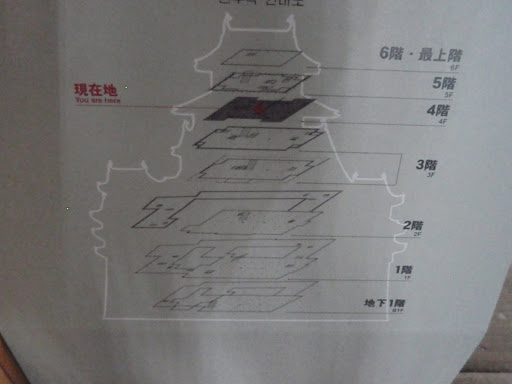
In Himeji, was as it should be for an ordinary fortress, and the main tower (or keep) themselves internally focused on defense. Thus the 5 floors mit Ausnahmen für ein paar Treppen komplett voneinander abgeschlossen, und diese Treppen sind extrem steil. Auch gab es auf den Stockwerken kleine geheime Räume, die, so vermutet man, dazu gedacht waren Soldaten zu verstecken, welche bei der Einnahme eines Stockwerkes noch einen Überraschungsangriff starten konnten, dies ist aber nicht gesichert.
Auch wurde mir ein paar mal die Frage gestellt warum ich nicht Schloß Osaka als meinen Herrschaftssitz gewählt habe. Osaka hat zwar auch eine bedeutende Geschichte, allerdings hat das Schloß für mich einen zu negativen Beigeschmack. So wurde es bereits 1615 (als es noch militärische Gegner des neuen Shogunats gab) erobert und das erste Mal zerstört, ca. 50 Jahre später It is after reconstruction due to lightning strike burned down almost completely during the Meiji Restauation it was destroyed a second time, the present building is indeed quite original, but just not the historic castle, moreover, there is, in spite of a large park just right in huge Osaka. In addition, Japanese are also often think that Osaka Castle is actually pretty ugly. Himeji is associated with
just some good feeling and pride, it's a bit difficult to explain, but certainly slight, most understand me and it is also aesthetically seen, the better decision.
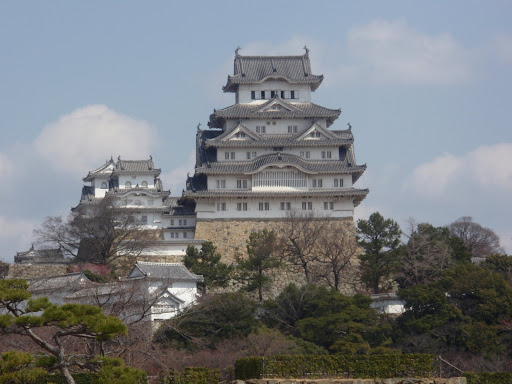
Castle when the main road kommt und im Park steht. (Hauptturm und letzter Seitenturm)
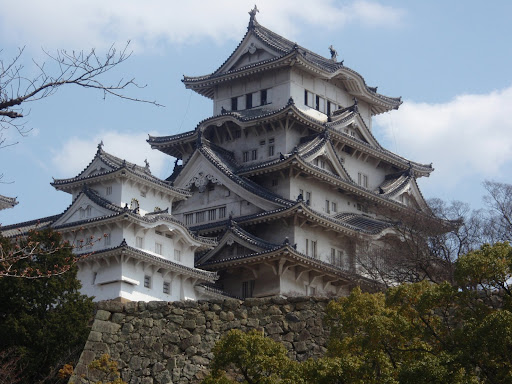
Seitenansicht
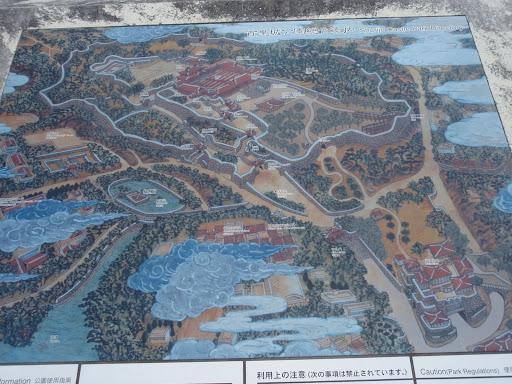
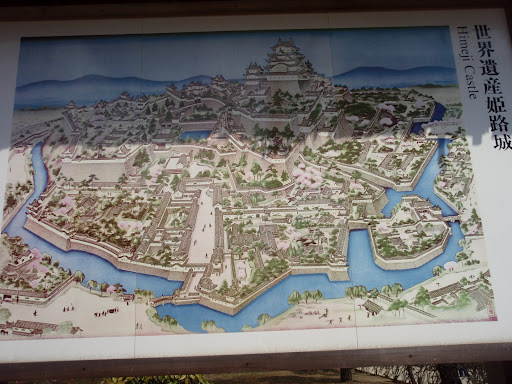
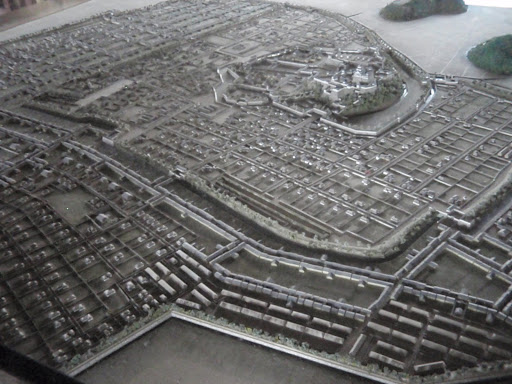
Zeichnung der Anlage und der umgebenden Stadt aus der Edo-Zeit
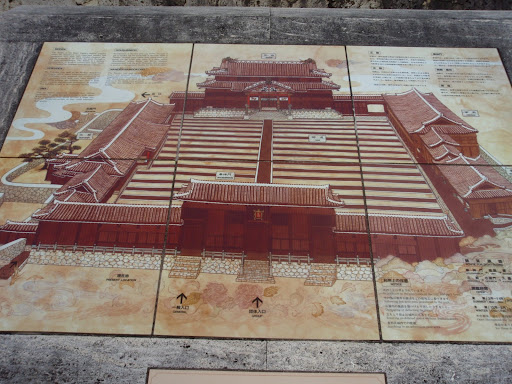
Eine schematische Darstellung des Hauptturms
Interessante (und lustige) Fakten/Meinungen über Japan:
Leider gibt es weiterhin keine Anhaltspunkte auf den Aufenthalt unseres Autors, doch haben wir per Mail einen Beitrag für die Kolumne erhalten. Da es sich aber nicht eruieren läßt, wann dieser verfaßt wurde, können wir noch nicht Entwarnung geben, und auch die Belohnung für sachdienliche Hinweise bleibt weiterhin aufrecht.
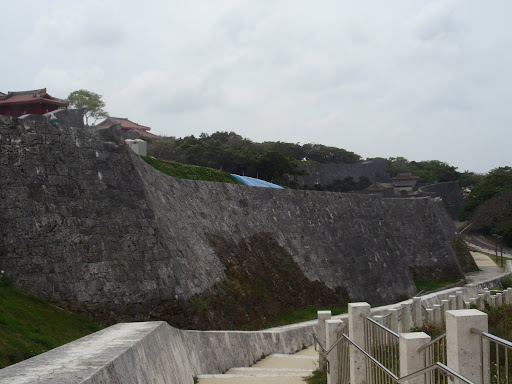
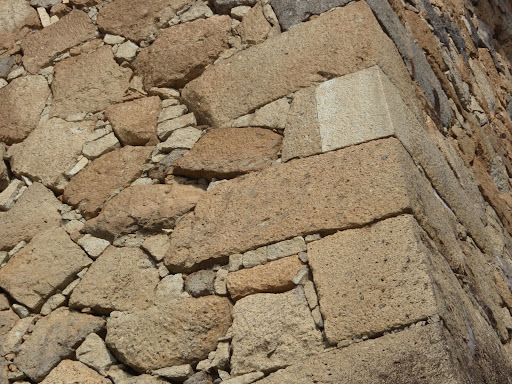
An dem Schloß/an der Burg (in Japan ist es eine Art Kombination von beidem) Himeji kann man sehr gut architektonische Charakteristika begutachten. Die Steine der Wehrmauern sind nicht sauber ineinadergefügt (wie in Europa oder auf Okinawa sichtbar) sondern wegen den verschiedenen Größen und Formen mehr wie aufgeschüttet, dennoch ist es eine bauliche Meisterleistung, daß sie dennoch eine sehr starke Befestigung darstellen. Die Verschiedenartigkeit rührt übrigens daher, daß es beim Bau einen starken Mangel an Steinen gab, sodaß man praktisch alle verwendete, derer man habhaft werden could, with very few were really trimmed properly. Very good you can see, therefore, those that come earlier from the temple standing at this point. The walls of the towers are beautiful but whitewashed and appear intact, so it is often used as a backdrop, for example in Akira Kurosawa's "Ran".
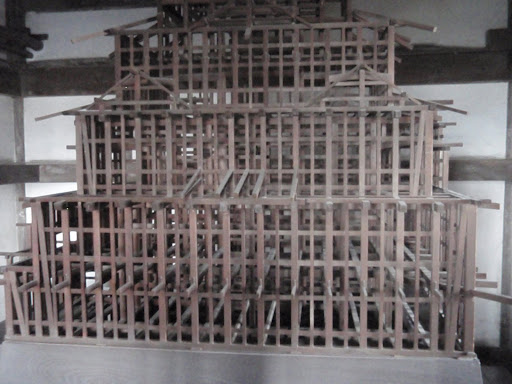
As for Japan, but was typically one of the main wood materials, so are the interiors of the towers built almost entirely of wood, and in general, the basic framework to a complex combination of wood uprights. The core of the main tower of the castle and thus actually make it two 24 meter high wooden pillars dar.
However proved the construction of wood core, stone plant and stone retaining wall or weir, with wood trim to be very stable. In addition, the city Himeji, as in the Edo period was divided common in well-defined neighborhood: administrative or samurai district, artisans 'quarter and dealers' district (and now and then a separate entertainment area) who ruled with the castle as the center around her and again separated by walls and gates were. Sometimes
was also lucky enough to help. Sun Himeji was in the 2nd World War II, although the area was bombed and badly damaged around the castle, the castle itself survived intact the attack. In the '50s, the castle was then partially removed, because after centuries the wooden frame for Verrotet part was strong and had to be renewed, did not want to risk that the castle collapses at some point. Among other things, the two wooden pillars were replaced with new ones. Nevertheless, it was meticulously made sure that up to the parts that had to be replaced, everything went back to its original place and it was used the same types of wood and some of the old processing techniques for restoration.
Like any significant castle Himeji castle also has its own legends.
As mentioned, it was the time when Toyotomi Hideyoshi (then still called Hashiba Hideyoshi), remove the castle had a severe shortage of stones, to him a poor old woman her millstone for the construction presented. In view of this selfless act now started to send all residents of the surrounding rocks from their possession (of the houses, etc.) to the castle lord, which was only enough material is collected.
This story is considered today to be true, and the millstone of the old woman is identified separately in the middle of the wall.
Okikus well planned
Around 1470 a noble castle of a plot against the Lord's castle to kill him and take his country to be able to. One of the Diennerinnen his family called Okiku heard of this plan and told him of her lover, a loyal Subordinates of the lords, so the plan was foiled. However, it was the main schemer itself nothing can be proved, so he is not of suspicion. When he found out who had betrayed the conspiracy, he took revenge on cruel way: He was one of the very valuable saucers steal the lords, and made it look as if his servant Okiku the culprit. Since he was attacked by the "crime" of his servant in his own honor, he had them tortured to death as punishment and throw into the well before rescue her lover, or anyone else they could.
Legend has it that at times we still can hear their mournful cry of lament from the well, they should dort ohne Unterlaß die Untertassen zählen, in der Hoffnung, daß sie wieder komplett sind.
Anscheinend hat es später aber auch den Intriganten erwischt, als er eine neuerliche Verschwörung plante wurde auch diese aufgedeckt, aber diesmal konnte er zur Rechenschaft gezogen werden.
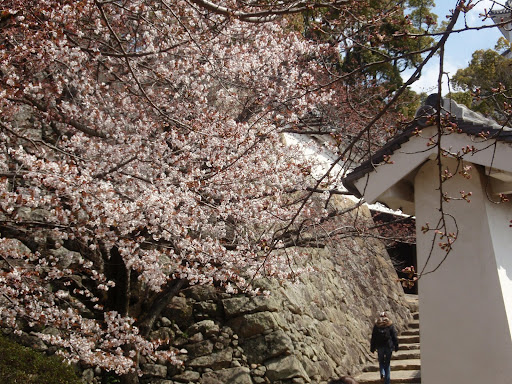
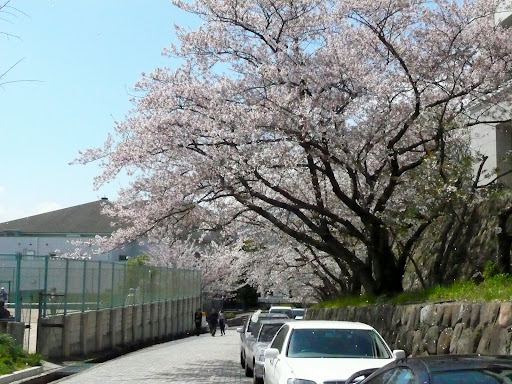
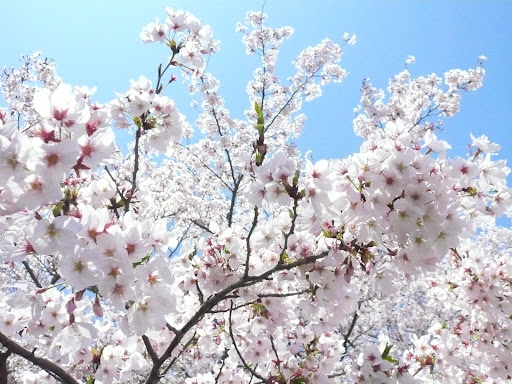
Heute zählt Schloß Himeji nicht nur zu den nationalen (Kultur)Schätzen Japans und ist einer der drei berühmten Schlösser, sondern steht auch auf der Liste der Weltkulturerbe der UNESCO. Zudem gilt der Garten bzw. Park des Schlosses mit seinen Kirschbäumen als einer der schönsten Orte der Präfektur für das alljährliche Hanami, das Betrachten der Kirschblüten.
Ein Abschnitt the wall, some well-carved stones of the old plant, partially donated stones
A model of the wooden brace
model of the city at the time of the Tokugawa Shogunate
And finally: The trees in the castle had already begun to bloom, but unfortunately they were and especially in the park far from their original splendor of full bloom.