It now longer, no new posts have been because I spent almost a week on Okinawa and the Ryukyu Archipelago (more on that later) and also had something else on the road.
Some time ago I was with Svenja and her friend Sara, who is visiting for a few weeks, a fine location on Amano-hashidate (天桥 立), the translation is just sky bridge. The sky bridge is a natural (almost continuous) curved land connection between two sides of the bay and is one of the official three most beautiful views of Japan.
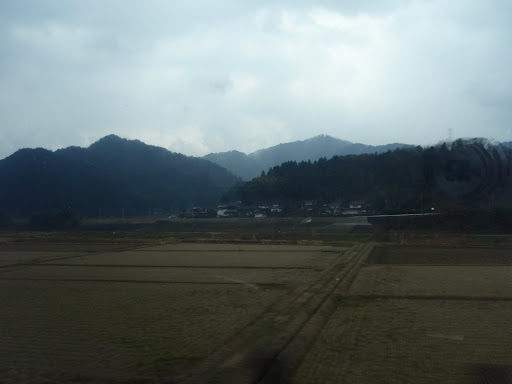
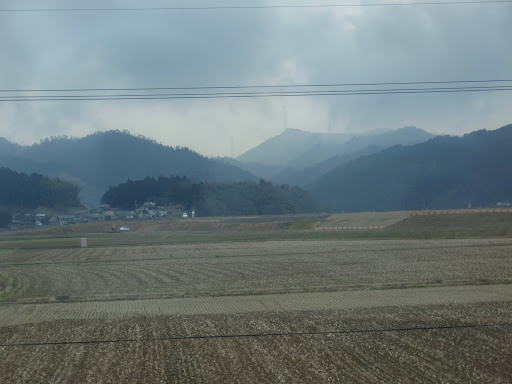
It is located almost opposite of Kobe on the north coast of Honshu and is easily reached by train. During the ride you get to see the country (country, unlike the city), and I can prove by means of pictures, what many people do not often think: Japan has many almost deserted urban areas and is in no way consistently. If you take the train (in the first Shinkansen line) goes, one can observe the very good: Huge urban areas, then nothing, just woods, in between a couple of villages and fields, then huge urban Moloch, and so on.
Because of the geography and the terrain (hilly) live most of the nearly 127 million people in some large metropolitan areas of Japan and several large cities, while in between the country over long distances seems almost deserted.
Back to the bridge. We were a little unlucky with the weather at the start the sun came through though, but then it was cloudy and it started to drizzle, so the natural beauty is unfortunately hardly come to bear.
Here again is a schematic representation of the peninsula
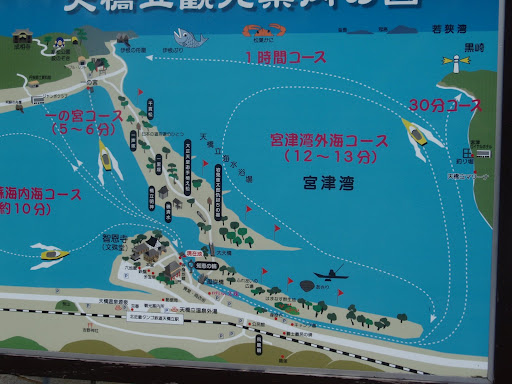
The Point is mainly covered with pine trees (= pine) covered and in particular has the open side of the Japanese sea off to a beautiful beach, which in summer attracts masses of tourists. Although the bridge eine Riesentouristenattraktion ist (vor allem für Japaner), ist der Weg für die Bewohner der Stadt, die anders heißt, ein ganz normaler Pendlerweg auf dem die z.B. die Schüler täglich unterwegs sind. Natürlich ist zwecks der Erhaltung der Natur das Befahren durch Autos verboten, und auch durch Sperren unmöglich (ausgenommen Fahrzeuge der Pflegetrupps).
Ein paar Eindrücke des Übergangs (auf den Bergen in der Nähe lag übrigens noch Schnee)
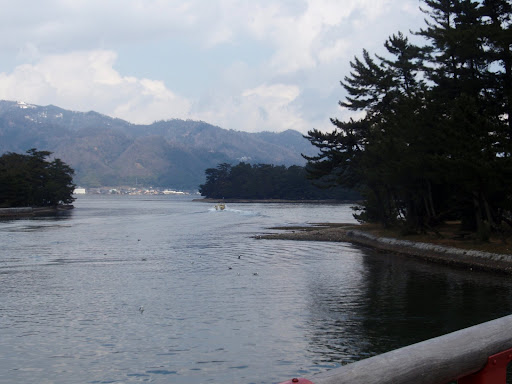
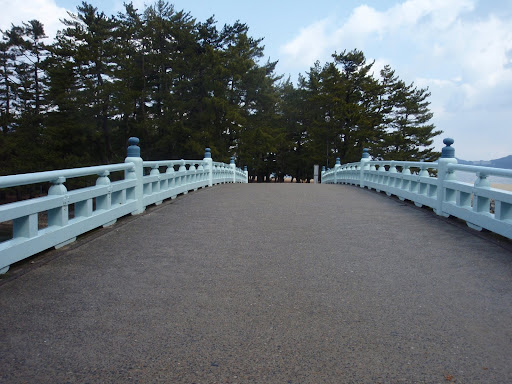
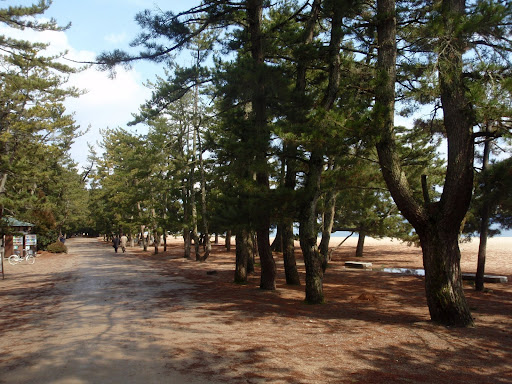
Die Reisenden

Angeblich hat man den best view, if you look at a few kilometers away, on a hilltop place, I believe in a park goes, there is with his back to the bridge on a bank and then prevents and considered the bridge between his legs. By then the water, etc. to act as the bridge would actually float between skies and earth. Since we have not known in advance, it not a beautiful day and the park even further away, I can not confirm, unfortunately.
There is also a famous ukiyo-e like this picture. Incidentally, I've read in my short, and now know that the technical term for a phenomenon such as Amano Hashidate, Nehrung ist.
Interessante (und lustige) Fakten/Meinungen über Japan:
Zu den drei schönsten Aussichten Japans gehören neben Amano-Hashidate die 249 Föhreninseln von Matsushima und die heilige Insel Miyajima mit dem berühmten im Wasser stehenden Torii (normal japanisches "Tor" zu einem Shinto-schrein), nahe Hiroshima. Die Aufstellung dieser drei Aussichten geht zurück auf den Autor Hayashi Razan, der sie im Jahr 1643 geschrieben haben soll, womit es keine moderne Auflistung ist und eine lange Tradition hat. Wie in einem anderen Bericht bereits erwähnt, gibt es noch viele andere Listen für die drei schönsten Gärten, die drei schönsten/ältesten Onsen etc., but the three most beautiful views are still the most important collection. Accordingly, many Japanese are trying to have these three admired at least once in their life in kind.


0 comments:
Post a Comment