Ich hoffe nach diesem Eintrag wieder zum gewohnten Mittwoch bzw. Mittwoch-Wochenende Rythmus mit meinen Updates zurückkehren zu können.
Also, wie bereits erwähnt waren die Tage nach dem Schitrip gefüllt mit Arbeit für die Uni, doch nach dem Erledigen dieser nervigen Nebenbeschäftigung, hat sich diese Woche auch wieder interessantes ereignet.
So habe ich zusammen mit einer Freundin eine Ausstellung im Stadtmuseum von Kobe über Ukiyo-e (浮世絵) besucht. Ukiyo bedeutet soviel wie "die vergängliche Welt" also so in Richtung des Diesseits und "e" steht in diesem Fall einfach für Bilder. Ukioye sind die, in der Edo-zeit aufgekommenen, japanischen Farbholzschnitte (auch zum Drucken bestimmt) und auch Bilder, wobei die Darstellungen sich auf das alltägliche Leben der Menschen, ihre Feste (sehr oft wurden bekannte Kabuki-darsteller gemalt) und der Umgebung konzentrieren, was ein Novum in der japanischen Kunst darstellte, was vielleicht ein wenig vergleichbar with the Biedermeier period, even as regards the middle class is. In the Western world, ukiyo-e became the term for traditional Japanese image representation, with well-Katsushika Hokusai and his series "36 Views of Mount Fuji" is most famous.
particularly interesting for me personally, is that Japanese Ukiyo-e also had some influence on European art after the opening of Japan, it was van Gogh greatly inspired by them and would build on the search for a "Japanese Landscape" in France have gone to his paintings, along the lines of ukiyo-e, can be oriented to this. He has also reproduced some known Japanese works in his style and colors.
Other artists whose works were influenced by ukiyo-e were, including Gauguin and Klimt.
Ukiyo-e but also contains "vulgar" displays, such as images of courtesans and sex scenes, so they sometimes had problems in Japan itself (although more with the past than by legal constraints), or they are rejected by many Western critics were. Also, because of their depictions of the simple life, a critique must ask how well the Biedermeier and over again.
was
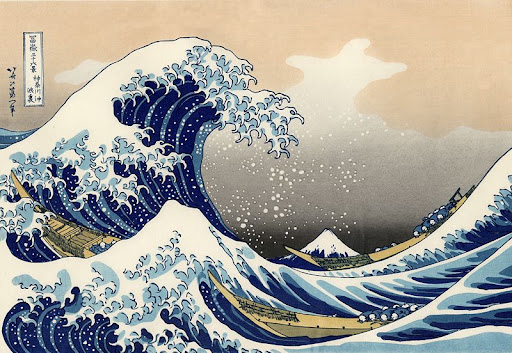
Unfortunately, as prohibited in most museum, photography strictly, so I can own heart no photos. Instead, a representation from the Internet, do not worry, 200 years after the copyright has expired: "Die große Welle von Kanagawa" aus Hokusais "36 Ansichten des Berg Fuji"-Zyklus (Das Original habe ich im Museum gesehen)
Das Besuchen der Ausstellung hat mir auch wieder vor Augen geführt, warum ich Moderne Kunst, insbesondere Abstrakte, nicht ausstehen kann. Wenn man die Bilder betrachtet, die Details, das Zusammenspiel der Farben bzw. die Farbpracht selbst, die Athmosphäre, sowie die Kunst z.B. mit nur Abstufungen der Farbe Blau auf weißer Leinwand ein wunderschönes und ästethisches Bild zu schaffen, so muß uns die moderne abstrakte "Kunst" dagegen als amateurhaft erscheinen. Egal ob es sich nun um Kunstrichtungen wie Jackson Pollock und sein "Action Painting is ", or the like which has arisen in the past 50 years, find where to but especially in Austria, Mühl and Nitsch extreme representatives.
What bothers me is the separation of vision and ability. An artist should and must of course have a vision to create a great piece, but now seems the term vision for a self-runner to have become, without simultaneously also exceptional skill needed. Often they seem to only have to do something exciting or abstract, and to know a marketing executive who knows this to market and sell it as art and it is already known, solange man behauptet, man hätte eine Vision zu diesem "Werk" und sie darin verarbeitet bzw. man will etwas damit ausdrücken. Ich nehme mich selbst als Beispiel: Wie schon mal gesagt, bin ich im Bereich der darstellenden Kunst ein Totalversager (Gott sei Dank nicht in der Musik), aber ich kann auch einen Kübel Blut auf eine Leinwand schütten, ein Loch in eine Dose Farbe bohren und über ein Gemälde tragen, oder Kugeln in Strumpfhosen stecken und diese zusammennähen. Doch man setze mich vor ein Gemälde von Da Vinci, van Gogh oder Klimt und erkläre mir ich solle es nachmalen, und ich werde denjenigen einfach nur auslachen und gehen.
Auf den Punkt gebracht ist meine Meinung, daß wirkliche Kunstwerke ohne technische Tools are not easy to copy.
is The sad thing that nowadays often artists with great skills and potential have no chance to become known as their images from the scene, and by many critics to be too exciting or spectacular enough to be regarded simply as "good". If you look at the history of art, the irony is unmistakable here.
I apologize here for the long paragraph about my personal views, especially because it has nothing to do with Japan, but I had to get rid of it easily.
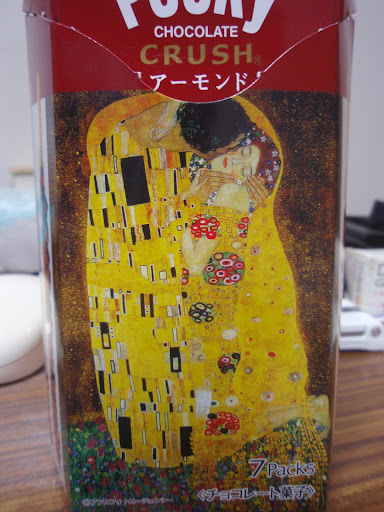
Since we have spoken of Klimt, here is a print on a box of Pocky (Schokolade sticks)

Eine andere Packung hatte den Aufdruck eines Bildes von Renoir ("Junges Mädchen trägt Blumen")
Auch war ich diese Woche in einem Restaurant mit Okinawa-Küche essen. Diese besitzt aufgrund der langandauernden chinesischen Einflüße, aber vor allem wegen ihren kulturellen Eigenheiten, einige spezielle Besonderheiten, die man nirgendwo sonst in der japanischen Küche finden kann. Leider hatte ich meine Kamera nicht dabei, weswegen es keine Photos gibt, aber wenn ich wieder dorthin essen gehe, werde ich sie nicht vergessen.
(Für die Anime-Fans unter euch: Der Anime "Samurai Champloo "takes its name from the Okinawa-court" champuru, "which means" means Mix "and refers to the mix of modernity and tradition in this anime)
I apparently the only (Western) Gaijin (foreigners) at the restaurant have been held, the waitresses (there were only girls) a little joke with me. It is normal that a waiter when a guest walks past in them, welcome him, or if he is on the way to the exit to adopt him, but there there extra words in Japanese (I refer here to my entry about "irrashaimase), sometimes they also do this every time, even if it's the same guest. If you leave the restaurant, will be coming out of the nearest waiter standing still before extra, so it corresponds to the courtesy.
Anyway, while we entgegengenahmen now after eating the bill, have been behind me unnoticed (Japanese can do so) set up all the waitresses in a semicircle, and as I set foot on the first step of the stairs towards the exit, all have same time, quite noisy (with a broad grin on his face) "Come back please!" called, and they were amused if my surprised face.
interesting (and funny) facts / opinions about Japan:
The island Okinawa (冲 縄) is actually only the name of the main island of Okinawa prefecture, which consists of a whole chain of islands, whose real name Ryukyu (琉球) is. Originally own the Ryukyu Islands, due to intensive contacts with China and other Asian countries, and their relative autonomy until the early 17th Century, a distinct culture and language that the Japanese today is very similar, but may still be considered to be distinct, especially in terms of the Okinawa dialect, but is clearly different from standard Japanese.
The Ryukyu Islands were in the Middle Ages (from about 1000) an independent kingdom that was indeed strongly influenced by China and also pay tribute contributed to China, but due to China's policy of quasi-isolation for a very long time was virtually sovereign. In 1609, then took a daimyo, with the approval of the Shougun, Ryukyu, which she formally lost its independence, as well as the daimyo with tax obligations, and less direct control was satisfied, could the culture continue to exist relatively independently, especially since the King continued was maintained at the Chinese embassies in control by Japan not to disclose. Thus was
Ryukyu but more or less double in dependence on China and Japan, which led to some problems and tensions in the population, the reforms became necessary, which in effect led to a boom and a further strengthening of the specific characteristics of Ryukyus.
After the Meiji Restoration in 1868, and the separation from China (since Japan China defeated in several battles), there but for the establishment of the prefecture of Okinawa, and consequently the final elimination of the king, the direct control of all spheres of life by the government in Tokyo and the increased spread of Japanese culture and language of the main island (which is now often regarded as a kind Assimiliationspolitik).
Okinawa is particularly known for his role in the 2nd World War, as it is the only venue for a battle on Japanese soil really lived (Iwo Jima with the exception of Militär praktisch unbewohnt), und nach Iwo Jima die 2-verlustreichste Schlacht der Amerikaner im Pazifikkrieg war. Bis in die '70er standen die Inseln dann auch unter amerikanischer Besatzung und Verwaltung, noch heute befindet sich dort die zweitgrößte US Marinebasis des Pazifik. Das Verhältnis zwischen der Bevölkerung der Ryukyu-Inseln und der Regierung in Tokyo ist immer noch etwas gespannt, da erst ungefähr in den letzten 10 Jahren begonnen wurde die ursprüngliche Kultur und Sprache der Inseln zu fördern (allerdings nicht vom Staat), wobei vor allem die Sprache ein Problem darstellt, da viele Junge in die Städte der Hauptinsel auswandern, und den Okinawa-"Dialekt" nicht mehr beherrschen.


0 comments:
Post a Comment